

There are bike races, and then there is Strade Bianche.
While the cobbled Monuments of spring get the headlines and the Tour de France gets the television audiences, Strade Bianche does something no other race on the calendar can quite replicate. It drops the world’s best cyclists onto the ancient white gravel roads — the strade bianche — of Tuscany, runs them through vineyards and olive groves, and spits them out, dust-caked and broken, into the medieval Piazza del Campo in the heart of Siena. It’s brutal. It’s cinematic. It’s one of the few races where even hardened cycling fans will sit forward on the couch, mouth open, not quite believing what they’re watching.
And on Saturday, March 7, 2026, it happens again — with a twist.
Why Strade Bianche Is Unlike Any Other Race
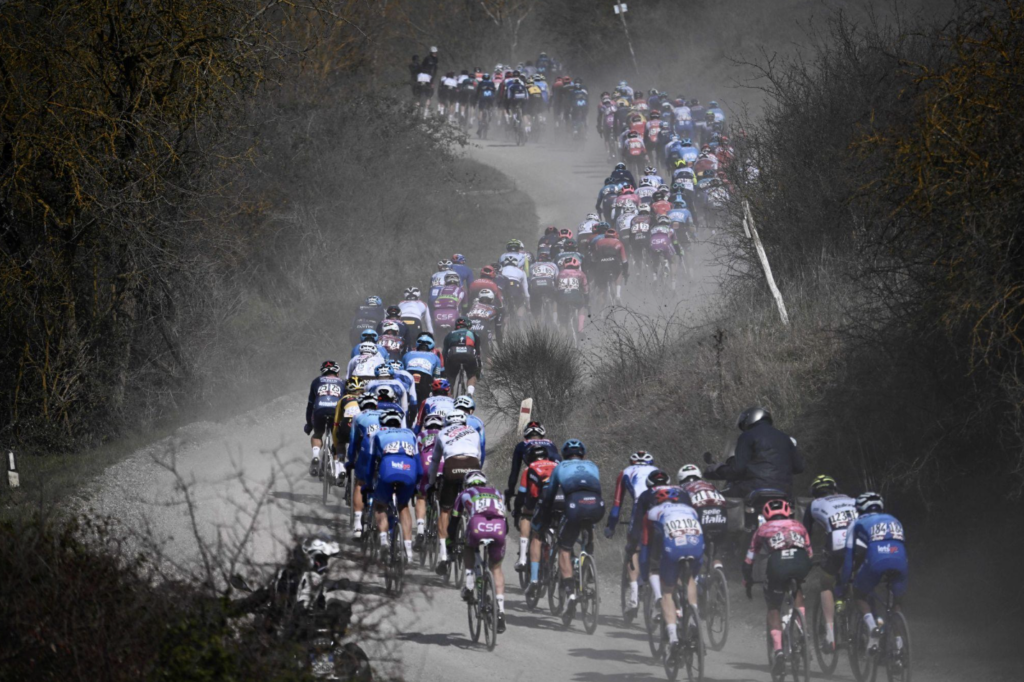
The magic starts with the strade bianche themselves. These aren’t just unpaved roads. They’re ancient Etruscan and Roman routes that carve across the Crete Senesi, the dramatic clay hills south of Siena. In dry conditions the white limestone dust coats everything — bikes, jerseys, faces — until riders look like Roman statues come to life. In wet conditions, that same dust turns to thick terracotta mud that clogs drivetrains and doubles the effort of every pedal stroke.
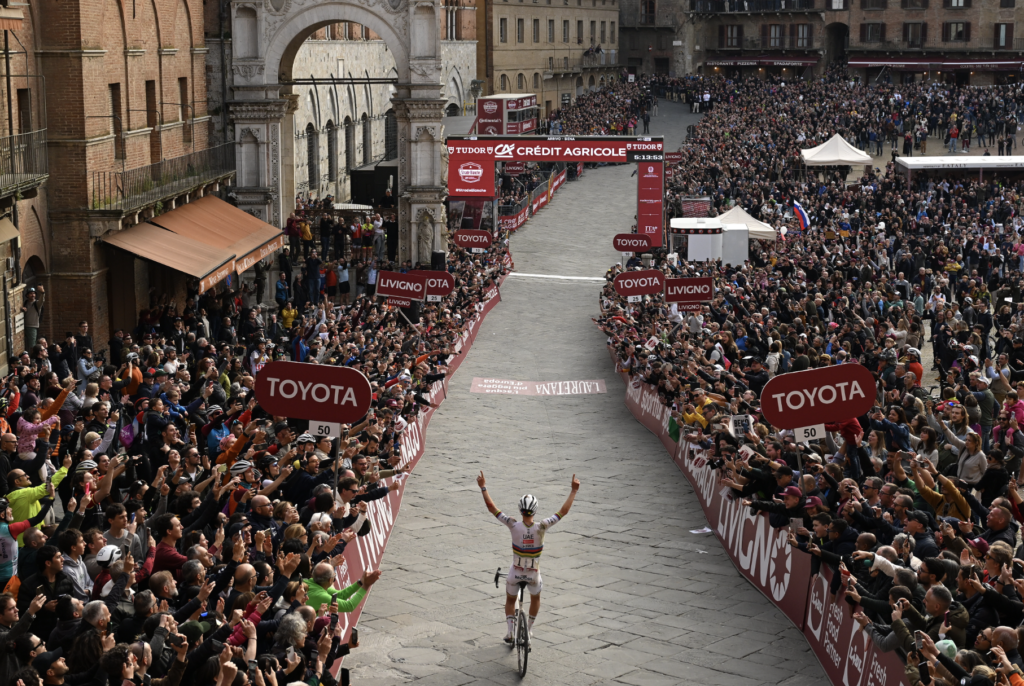
The race ends in arguably the most spectacular finish in professional cycling. The final sector, Le Tolfe, is a brutal cobbled climb just a few kilometers from the finish line, rising sharply out of the Tuscan countryside and dumping riders directly onto the narrow streets of Siena’s historic center. From there it’s a short, winding run into the Piazza del Campo — the famous shell-shaped main square where the Palio horse race has been held for centuries. Tens of thousands of fans line every inch of it, packed into the medieval square, screaming, as riders crest the final rise and sprint for the line. There is no finish in cycling quite like it.
The race is also relatively young by Monument standards, having been founded in 2007. This means the history is still being written, and in recent years, one man has been doing most of the writing.
The Pogačar Problem (and the Organizers’ Answer)
If you’ve watched Strade Bianche in recent editions, you know the storyline: Tadej Pogačar goes to the front, the race explodes, and a very long solo ride into Siena follows. It’s been dominant, jaw-dropping, and — if we’re being honest — a little bit predictable.
Organizers took note. For 2026, they’ve made some of the most significant route changes in the race’s history, trimming total gravel from around 80 km down to 64 km and removing two early sectors — La Piana and Serravalle — from the equation. The goal is to change the rhythm of the race: less early attrition, more energy saved for a ferocious late-race explosion.
The gravel that remains is, if anything, more strategically placed. Vidritta, Bagnaia and Radi come early to soften legs, followed by a long lull, and then Lucignano d’Asso — the first four-star sector and the longest gravel stretch on the course — arrives just when the race is ready to boil over. The iconic sectors that define what Strade Bianche is — Monte Sante Marie, Colle Pinzuto, and Le Tolfe — are all still there. The character of the race is fully intact. Organizers have simply rebalanced it, trimming the early grind and hoping to replace last year’s long-range domination with a late, all-in shootout on the final white roads.
The result, in theory, is a race that stays together longer and then detonates harder. A race that demands late-race courage rather than early-race brute strength. A race that could, finally, produce a real fight into Siena rather than a coronation.
The Riders: A Field That Deserves a Feature Film
Even with the route changes, Strade Bianche 2026 would be appointment viewing based on the start list alone.
Tadej Pogačar (UAE Team Emirates) is back. Despite being the reason for the route changes, the Slovenian is targeting a third Strade Bianche win and is making this race his first road appearance of the 2026 season. No build-up races, no warm-up. Just straight to Tuscany. That tells you everything about how much he values this race.
Wout van Aert (Visma–Lease a Bike) is the man most likely to have something to say about that. He’s a former Strade Bianche winner himself, with serious gravel credentials and a Giro stage on these roads already on his palmarès. Perhaps most importantly, he’s been cited as the only rider to actually drop Pogačar in a race last season. He arrives hungry, fit, and perfectly suited to a race that now rewards punchy, dynamic racing over pure endurance dominance.
Tom Pidcock (Ineos Grenadiers) is a former winner who was practically born to race Strade Bianche. His ability to descend and corner on technical surfaces at full speed, combined with his explosive climbing, makes him dangerous from the moment the race hits gravel. The new, less drawn-out route could suit him perfectly.
Ben Healy (EF Education–EasyPost) and Matteo Jorgenson (Visma–Lease a Bike) are two riders specifically flagged as beneficiaries of the rebalanced course — riders who can survive the early gravel, save their legs through the lull, and then go deep in the final hour. A deep supporting cast, including Romain Grégoire, Giulio Pellizzari, and Quinn Simmons, adds further unpredictability to what is already an electric mix.
On the women’s side, the race is equally stacked. Demi Vollering and Lotte Kopecky of SD Worx–Protime are the established Strade Bianche powers, a formidable team that has dominated recent editions. But Pauline Ferrand-Prévot arrives off a big 2025 season with a stated goal of improving on her Siena podium — and in a race this physically demanding, she has the engine and the tactical intelligence to do it.
In short: Pogačar vs. Van Aert vs. Pidcock on redesigned gravel, with Vollering, Kopecky and Ferrand-Prévot trading haymakers on the same Tuscan dust. If there is one race to watch before the cobbled Monuments of spring, this is it.
How to Watch Strade Bianche 2026 Live
Both the women’s and men’s races take place on Saturday, March 7, 2026, with coverage throughout the day. Here’s where to find it wherever you are in the world.
USA & Canada
HBO Max will be broadcasting the race in the United States. However, you’ll need a premium account. You can find full sign-up and streaming information at HBO Max.
FloBikes is the confirmed rights holder for Strade Bianche in Canada. You can find full sign-up and streaming information at flobikes.com. FloBikes is available across essentially every major streaming platform — Roku, Fire TV, Google TV, Apple TV, Samsung, VIZIO, LG, iOS, and Android — so there’s no good excuse not to have it up on the biggest screen in your house by Saturday morning.
UK & Ireland
TNT Sports via Discovery+ is your home for Strade Bianche in the UK and Ireland. You can stream through discoveryplus.com/gb or find more information at tntsports.co.uk. Strade Bianche is confirmed on TNT Sports on March 7.
Italy
No surprise here — this is a home race. RAI broadcasts the race on TV, and the live stream is available through RaiPlay. If you’re in Italy and not watching this, hand in your cycling fan card immediately.
Belgium
Flemish speakers can catch it on Sporza at sporza.be, while French-speaking Belgium is covered by RTBF Auvio at auvio.rtbf.be.
Netherlands
NOS Sport has the race at nos.nl/sport.
Switzerland
SRF Sport covers it at srf.ch/sport.
Slovenia
Planet TV has coverage at planet.si.
Australia
SBS carries the race and streams it at sbs.com.au/ondemand/sport.
Japan
J Sports is your destination: jsports.co.jp/cycle.
Colombia
RTVC broadcasts Strade Bianche at rtvc.gov.co.
New Zealand
Staylive streams the race at staylive.io.
If you’re outside any of these territories, check your local Eurosport or Discovery+ listings, or check with your national broadcaster. And if you’re traveling, a VPN used in line with local laws can help you access your home broadcaster’s stream.
For the most up-to-date and comprehensive broadcast guide across all regions, Cycling Up to Date has you covered.
Clear Your Saturday Morning
Strade Bianche isn’t just a bike race. It’s a spectacle set against one of the most beautiful landscapes on earth, raced by the best cyclists in the world, on roads that have existed for thousands of years. The 2026 edition has been redesigned to produce the kind of racing that keeps you on the edge of your seat rather than waiting for the inevitable, and with the field that’s been assembled, it has every ingredient to become an all-time classic.
Set your alarm. Pull up FloBikes, TNT Sports, or RAI. Make some super strong coffee. And when you’re watching Pogačar and Van Aert battle through Monte Sante Marie on Saturday, know that in June 2027, Avanti Tours athletes will ride those same roads. Our Tuscany Gravel tour waitlist is open now.